what was the specific mission of the tuskegee airmen
 Web Cognitive content Exhibit
Who were the Tuskegee Airmen?
In the 1940's, the One States Military machine, the likes of so much of the nation, was segregated. The supposed Jim Crow Laws kept blacks from entering public places such as libraries, restaurants and movie theaters. Although African Americans served in the war machine, they were restricted in the types of jobs and positions they could hold.
Connected April 3, 1939, President Roosevelt approved Public Natural law 18, that provided for an expanding upon of the Army Bare Corps. One section of the law offered hope for those African Americans who wanted to advance their noncombatant careers on the far side the kitchen surgery the centrifugal kitty. It called for the creation of training programs to be located at black colleges which would prepare blacks for service in a variety of areas in the Air Corps support services.
On January 16th, 1941, the War Department announced the creation of the 99th Pursuit Squadron. This was to be an all black winged building block house-trained at the Tuskegee Found founded in Tuskegee, Alabama, by Booking agent T. Washington in 1881. Charles A. Anderson, a self-taught African-American pilot had foreign a civilian navigate training course of study at the Institute in 1939.
Web Content Display
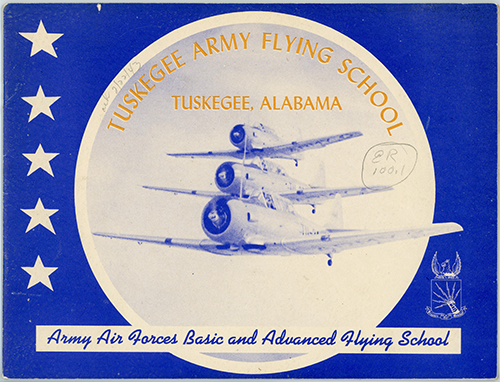 Tuskegee Plant Booklet - Airman Cecil Peterson sent Eleanor F. D. Roosevelt this 1943 promotional brochure. A yearly of sorts, the publication includes photographs of the Institute, its trainees and activities. Vertical Indian file, FDR Library.
Web Content Display
Since there were no black officers, eleven white officers were assigned to train and prepare a total of 429 enlisted men and 47 officers who would become the Tuskegee Airmen, the first black man in the aflare school. From 1941 to 1946 over 2,000 African Americans realized training at the Tuskegee Institute, nearly three quarters of them qualified as pilots.
The rest went on to become navigators or support personnel. Together they were far-famed as the Tuskegee airmen. During the war the 99th Pursuit Squadron, which was later renamed the 99th Fighter Squadron, flew in the skies all over the Mediterranean and Europe. The missions were primarily as bomber escorts.
The 99th Fighter aircraft Squadron had the distinguished record of never losing a bomber to foeman fighters. In addition to shooting down enemy attack aircraft, they also shot low the opinion that African Americans were not suited to trustworthy military Service. In 1948 President Truman ordered the integration of the US Government Military.
Find More: Pictures of African Americans During Second World War
Web Self-complacent Display
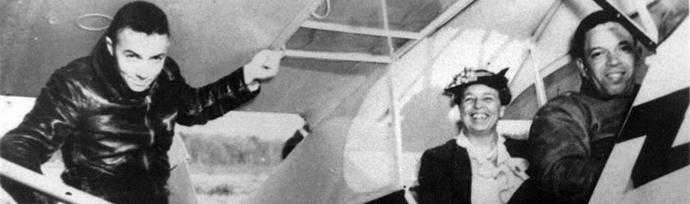
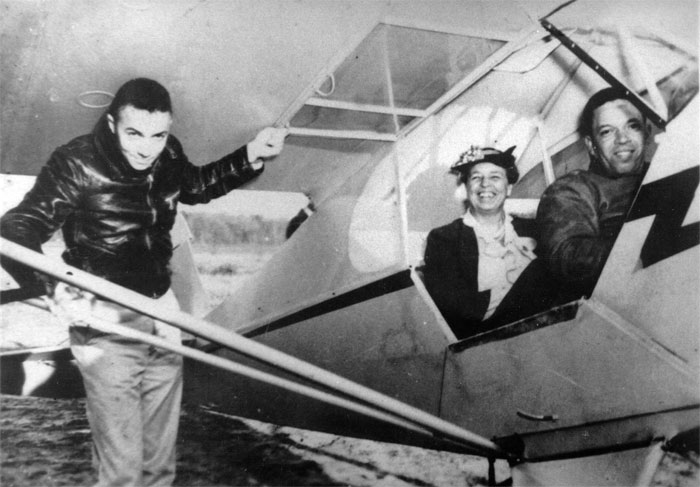 Main Noncombatant Flight of steps Instructor Charles Alfred Philip Anderson took Anna Eleanor Roosevelt on an hour-mindful flight of stairs during her 1941 visit to the Tuskegee Institute. Here they are pictured on base the aircraft concisely after landing. Airforce Historical Research Agency photograph.
Web Happy Display
Support From a First Lady
First Gentlewoman Eleanor Roosevelt was very involved in the work at the Tuskegee Institute, particularly in the aeronautical school. During a highly heralded 1941 visit to the Tuskegee Army Air out Field of battle, she asked to take a flight with one of the Tuskegee pilots.
Although the Mystery Help was anxious about the ride, Chief Civilian Flight Instructor Charles II Alfred Anderson, known nowadays as "The Father of Black Aviation," piloted Mrs. President Roosevelt over the skies of Alabama for all over an hour.
Flying with Anderson demonstrated the depth of Eleanor Roosevelt's support for black pilots and the Institute's preparation program. Press reporting of her adventure in flight helped counsel for the competency of these pilots and boosted the Institute's visibleness. Roosevelt was so impressed with the program that she established and well-kept a semipermanent symmetry with more or less of the airmen.
Web Content Presentation
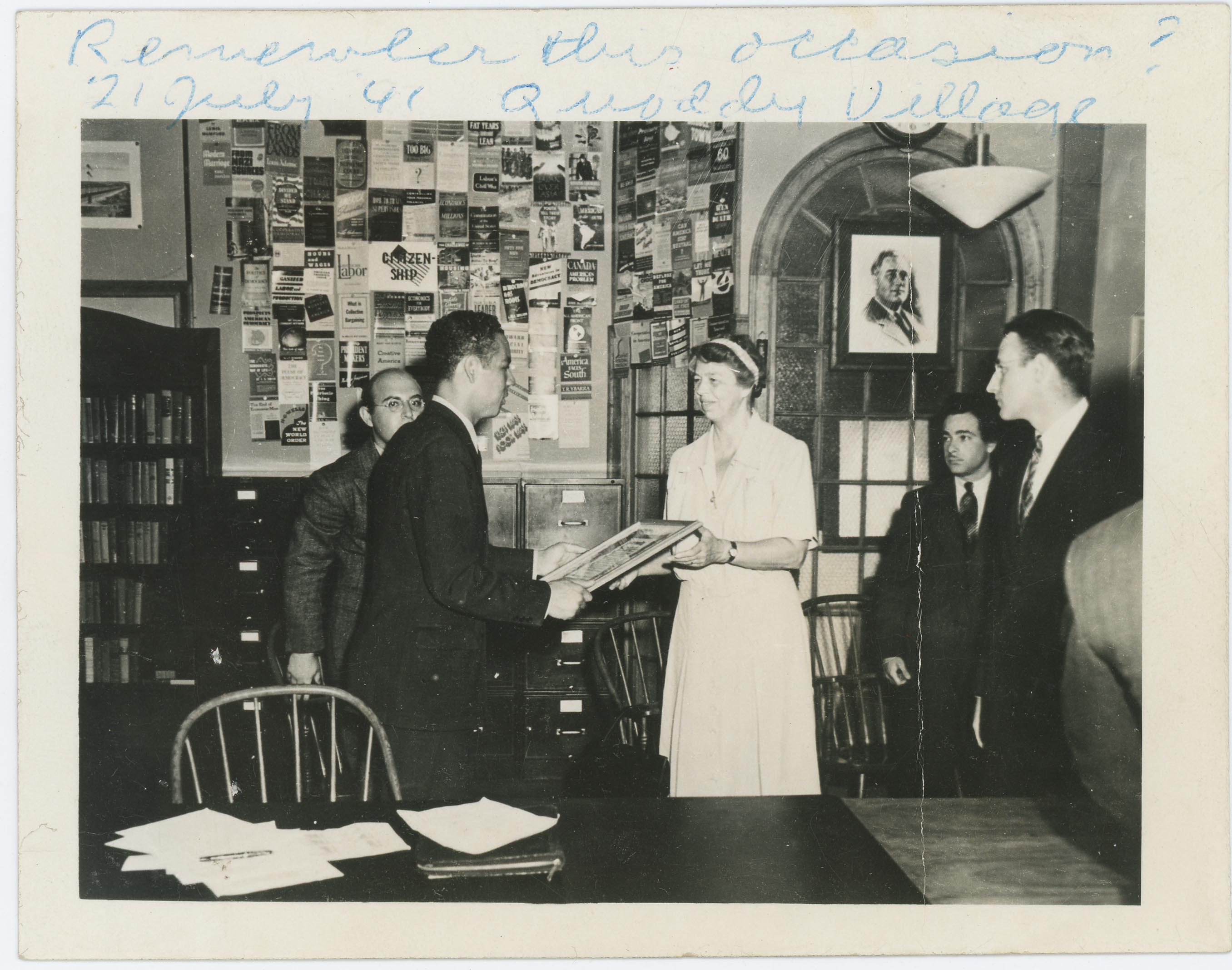 Eleanor President Theodore Roosevelt had met Cecil Peterson before helium became a Tuskegee Airman. Here F. D. Roosevelt accepts a plaque offered by Peterson, then representing the Student Government at an NYA-supported program at Quoddy Small town, Maine, July, 1941. Peterson wrote on the front of this print: "Remember this occasion? 21 July 41 Quoddy Village." FDR Library Photo: NPx 79-258.
Nested Portlets
Web Content Showing
 1942 State of war Bond poster featuring an African American navigate. FDR Library Museum Object: MO 2005.13.36.192.1
what was the specific mission of the tuskegee airmen
Source: https://www.fdrlibrary.org/tuskegee

Posting Komentar untuk "what was the specific mission of the tuskegee airmen"